Design
The footer
Set up everything at the bottom of every page: texts, links and the © line, with the contact details from the general details and variables for your texts.
The footer sits at the bottom of every page. It holds your contact details, a short text, opening hours, useful links and the © line. Go to Settings → Footer; the Preview at the top follows every change.
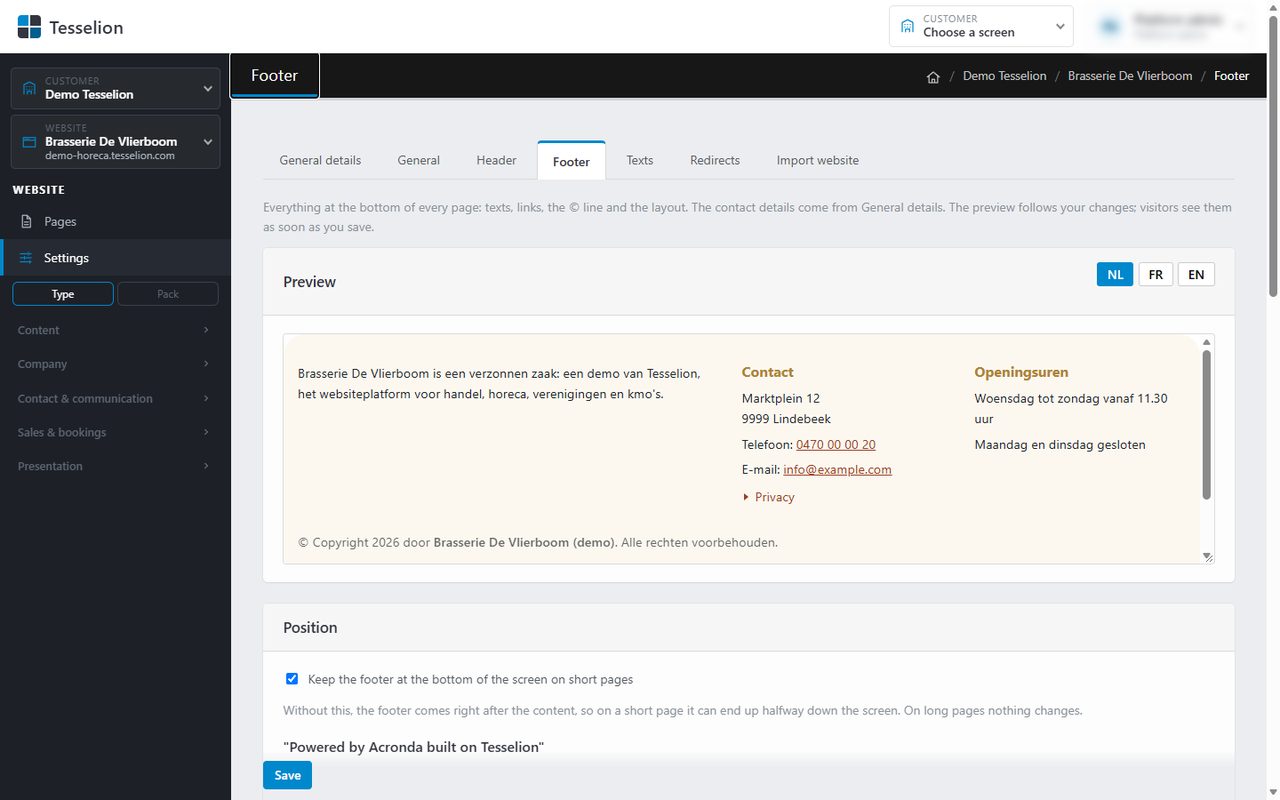
Contact details
The details of your organisation are kept in one place: Settings → tab General details. The footer, the header and your texts take them from there. The Footer screen links to that card.
- Fill in what you want to show: Name of the organisation, VAT number, Email, Phone, Fax, Street and number, Postal code, City, Country and IBAN.
- Pick a language next to Editing in and fill in the Opening hours, one line per day or period.
- Click Save.
Leave a field empty to hide it. Without a name of the organisation, the name of the site is used. The IBAN is checked; an invalid number is not saved. These details are also given to search engines, and phone and email can appear in the header's top bar.
Variables
Use the general details in your texts too: put a variable in a heading, a text block, a button, the footer text or © line, or the label of a link. The site fills them in, in the language of the page. When a detail changes, every page follows.
{{contact:name}}: the name of the organisation (empty: the name of the site){{contact:vatNumber}}: the VAT or enterprise number{{contact:email}}: the email address{{contact:phone}}: the phone number{{contact:fax}}: the fax number{{contact:address}}: the address on one line, e.g. “Church Street 1, 2000 Antwerp” (followed by the country, e.g. “…, 2000 Antwerp, Belgium”){{contact:street}}: street and number{{contact:postalCode}}: the postal code{{contact:city}}: the city{{contact:country}}: the country, in the language of the page{{contact:iban}}: the account number, in groups of four{{contact:openingHours}}: the opening hours in the language of the page{{site:name}}: the name of the site{{year}}: the current year
The variables also work in the subject and text of the emails of the site (e.g. a confirmation, a newsletter or a message from the secretariat) and in knowledge base articles. Text formatted as code stays as it is: that way you can show a variable instead of its value.
You do not have to type a variable. The toolbar of a text editor (e.g. a text block, a tab, a knowledge base article or the own text of the privacy statement) has the button {}. Next to an ordinary text field where variables work (e.g. the title of a Heading block, the text and the address of a button, the footer text and © line, the subject and text of a newsletter) you find the small button {} (Insert variable). A click opens the list, per group: Site, Contact (general details) and the modules that are on for your site, e.g. Competitions. Click a variable and it is placed at the cursor. The list only shows what works in that place: in an address only variables that give an address, in a text only text.
Tip: Below General details you find the full list, with a button to copy a variable. In the preview a mistyped variable stays visible; on the site it is left out.
Note: If a text contains a variable that does not exist (e.g. a typo), you see a warning below the text editor and after saving a page. Saving still works; the variable is just not filled in.
The pages a module makes itself have more variables: the details of the competition ({{competition:title}} ...) in the page layout of Competitions and those of the period ({{period:name}} ...) in the page layout of Courses. On an ordinary page they stay empty.
Texts per language
- Pick a language next to Editing in.
- Fill in the Footer text, e.g. a short introduction.
- Optionally fill in the Name in the © line. Left empty, the name of the organisation is used, or else the site name.
- Under Headings you can replace the titles of the footer columns. Left empty, they keep the standard text (shown in grey).
Links
- In the Links card, click Add link.
- Under Goes to, choose a page of your site or an address, and enter the Label in each language.
- Tick In Contact to show the link in the Contact column instead of with the other links.
Links are shown at the bottom, next to ©. With Show the links as a column “Useful links” at the top of the footer they get a column of their own.
Note: A link without a label in a language is not shown in that language.
Position and credit line
- Keep the footer at the bottom of the screen on short pages: the footer no longer ends up halfway down the screen on a short page.
- The line “Powered by Acronda built on Tesselion” is always shown at the bottom. You choose its Alignment and whether it sits On a line of its own.
Click Save at the bottom. Visitors see the change straight away.
Tip: Put a link to your privacy statement and contact page in the footer: that is often exactly where visitors look for them.
See also
Last updated on 20 November 2026