Getting started
Finding your way around the admin
How the admin is laid out: the pickers at the top, the Website and Customer groups in the sidebar, the user menu and the dashboard.
Once signed in, you see a sidebar on the left and the screen you are working in on the right. Everything in the sidebar depends on the organisation and website chosen at the top. What you see also depends on your role.
The pickers at the top of the sidebar
- Customer: your organisation. If you work for just one, only its name is shown. If you have access to several, click the name to switch.
- Website: the website you are working on, with its address underneath. If you have more than one, click to switch. The arrow next to a website opens it in a new tab. At the bottom are Manage websites and, if you may still create one, New website.
Manual and website in the Customer admin menu
At the bottom of the Customer admin menu (top right), when you have chosen a website, there are two more links, each after a line: Manual opens this manual in a new tab, and View website opens the chosen website (if it has an address).
The danger zone
Actions you cannot simply undo, such as deleting a website or customer, removing a user's access or turning off two-step verification, sit apart in a red Danger zone box, with a red button and a short explanation. Read it before you click. The small delete buttons (✕) in lists also have a red border.
The Customer admin menu
Under Customer admin at the top right (with the gear) you find what applies to your whole organisation: Dashboard and Websites. As an owner you also see Domains, Modules, Customer details, Subscription and Users.
The Website group
This holds everything for the chosen website:
- Pages: the page tree and the page editor.
- Settings: languages, theme, header, footer and other settings, spread over tabs.
- Below that, after a line, Site management: the website tools (such as statistics, SEO and maintenance) as tabs of one screen, when one of its parts is on.
- Then the modules turned on for this website, in alphabetical order. A number next to a module flags something that needs attention, such as new submissions.
When many modules are on, they appear in collapsible groups such as Content, Company, Contact & communication, Sales & bookings, Clients & members, Finance and Horses. Click a group name to open or close it. When you open the admin, the groups are closed, except the group you are working in. If you have packs, choose Type or Pack above the groups to see the modules by type or by pack. From ten modules onwards, a Find a module… search box appears above them.
The dashboard
Click a block with a figure to go to the matching screen.
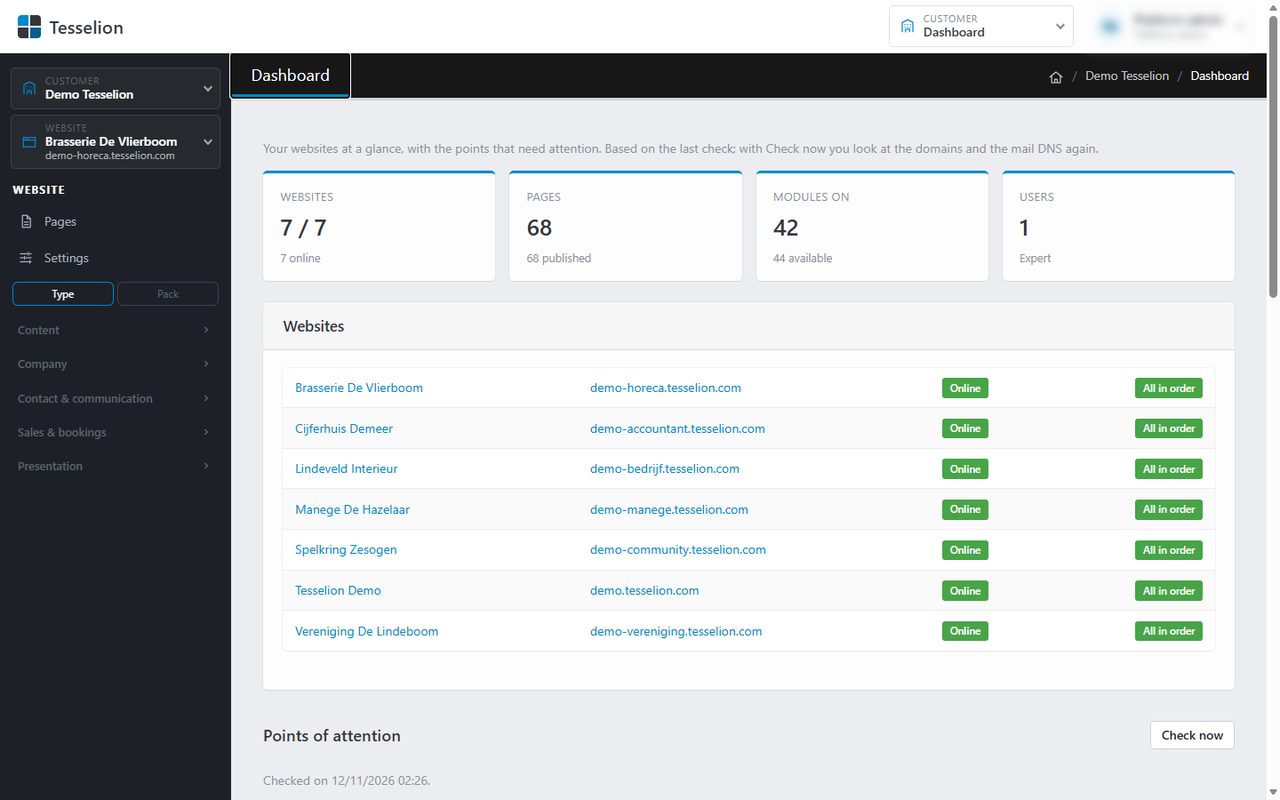
The Dashboard shows your websites at a glance: the number of websites (and how many are online), pages and modules turned on, plus, for owners, the number of users and the plan. Below that, each website is marked Online or Offline, followed by the Points of attention from the last check. Check now re-checks everything, including the domains.
Your user menu
Your name is at the top right. Click it for My profile, Sign-ins, Technical details and Sign out.
Tip: On a narrow screen, such as a phone, the sidebar sits behind the menu button at the top left.
See also
Last updated on 20 November 2026